
This blog post began as an answer to a question in "LinkedIn" Questions and Answers (embedded version of Yahoo Answers) to "Is There Room for Microsoft at the Linux Table?"
As I have a habit of ranting away rather than answering a question directly at first, let me get over with the answer bit first: Yes, and it's already, sort of already found a place.
Now for the reasoning rant... (okay, I know, I am politicising things again, but it's actually anti-policising things if you know what I mean... as a proof):
An ex-colleague and friend has confirmed that my blog is inaccessible in the
"People's Republic"...
 Big deal,... anything with the words politics is suspect in China anyway, not to mention their blogosphere and related sub-culture. Remember Sister Lotus (Shi Hengxia, 芙蓉姐姐 or Fúróng Jiějiě)? )
In the late nineties, while Microsoft Windows looked and acted very much, excuse my allusion, like a poor country cousin of Mac OS (and I am not even talking about the new Panther, Tiger or Snow Leopard OSXes but old GUI OSes like Mac OS 7.2 which I used back in mid-nineties), Linux became the de facto techhead OS. Suddenly, this free Unix like OS kernel and its distros became the secret powerful tool manager for techies and amateurs alike, and by 1997, Linux distros running OS GUI like Gnome Desktop, K Desktop Window Maker became so popular that we were thinking, hey, it's not only free lunch, they serve the beer free too.
| MS Windows | Mac OS | ... Linux |
|---|---|---|
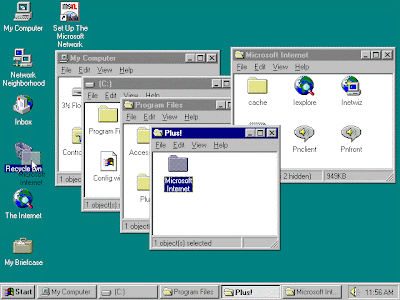 Microsoft Windows 95 for PCs were way behind in usability and even the "looks" in comparison to much older Mac OS. The reason it pulled off a marketing coup over Mac OS, never mind it's "clunkiness" and tedious "viral" infections owing to almost no security at all, was because it was a cheap alternative to Apple's proprietary OS which could only run on Motorola chips with which Apple MacIntoshes were manufactured at that time. Microsoft Windows 95 for PCs were way behind in usability and even the "looks" in comparison to much older Mac OS. The reason it pulled off a marketing coup over Mac OS, never mind it's "clunkiness" and tedious "viral" infections owing to almost no security at all, was because it was a cheap alternative to Apple's proprietary OS which could only run on Motorola chips with which Apple MacIntoshes were manufactured at that time. | 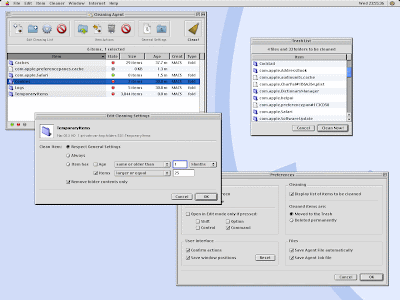 Mac OS 7 came with the LC and Power PC series in the early and mid-nineties and were growing strong for better rendering and manipulation of graphics, animation and multimedia back then but was usually out of reach of non-professionals because of the high costs involved. Mac OS 7 came with the LC and Power PC series in the early and mid-nineties and were growing strong for better rendering and manipulation of graphics, animation and multimedia back then but was usually out of reach of non-professionals because of the high costs involved. |  Linux distributions or "distros" as they are called have been available for a long time (since the early nineties) but unless there are some enthusiasts, or supergeek evangelists around, nobody seems to talk of them much. The average user whose numbers have grown by leaps and bounds to include almost anyone who has access to a home or office computer does not usually have access to it or do not know how to access it. But even in the late nineties, there were interesting "desktops" available packaged in with distros which ranged from pretty neat ones to the downright eccentric experiments like the Japanese "WindowMaker" Linux distributions or "distros" as they are called have been available for a long time (since the early nineties) but unless there are some enthusiasts, or supergeek evangelists around, nobody seems to talk of them much. The average user whose numbers have grown by leaps and bounds to include almost anyone who has access to a home or office computer does not usually have access to it or do not know how to access it. But even in the late nineties, there were interesting "desktops" available packaged in with distros which ranged from pretty neat ones to the downright eccentric experiments like the Japanese "WindowMaker" |
For technology enthusiasts, especially those who saw the "future" cloud computing in the sky, Microsoft Windows, its "viruses", "worms" and "trojans", and it's clunky apps which you had to pay to use were beginning to look like things of the past. Since then a lot has happened, but we have seen how the dot com bubble was created and how it burst, how Microsoft's brand image suffered, not in terms of the company's money power but for trying to monopolise the OS world and win the browser wars through "good old" business strategies which may be compared to the moves of any big industrial house.
Jaded academic or entrepreneur?
Rabble rouser?
At this time of writing this blog, Web 2.0 is already an old catchword for the informed and it has crossed over into other spheres never mind what detractors are saying. Web 2.0 has come under considerable attack. The most damning of what I have seen so far is from a person called Andrew Keen. This is a man who speaks somewhat in the guise of an academic but was an internet entrepreneurs in the early years of Dotcom Bubble. Then the bubble burst! And so it seems his own career in technology.
To re-invent himself, he has taken up what seems to be the best of his abilities, public speaking and writing. But when he does so, he sounds like a man in pain trying in vain to be politically, and morally righteous. This is where politics comes in through the back door. And trailing behind it, the issues that are central to every society, culture and nation: survival, education and values.
Andrew Keen has written a book, perhaps one of the first to criticise the Web 2.0 paradigm. When you think of it, you wonder, what has this chappie got against it all? Keen has put together the age-old ravings of some jaded and unsuccessful professional in their sunset years: rage against innovations. In case of Keen, it's technology and the latest innovations. That he missed the bus long ago is evident from his ravings; to read more into it, it 's nothing but alarmist outcries against perceived anarcho-Marxist threat and so-called inevitable signs of demise of the free market economy.
The bogey of Marxist takeover and inevitable collapse of Free Market sounds as real as his claim that Google is the same league as Nike or other big monopolies of the enlightened Capitalist world of the nineties. What Keen does not get is that none of this is the reality and somehow both neo-capitalism and communism are as passé as his outcries about the obscure cults of amateurs, a book he has authoured.
Rabble rouser?
At this time of writing this blog, Web 2.0 is already an old catchword for the informed and it has crossed over into other spheres never mind what detractors are saying. Web 2.0 has come under considerable attack. The most damning of what I have seen so far is from a person called Andrew Keen. This is a man who speaks somewhat in the guise of an academic but was an internet entrepreneurs in the early years of Dotcom Bubble. Then the bubble burst! And so it seems his own career in technology.
To re-invent himself, he has taken up what seems to be the best of his abilities, public speaking and writing. But when he does so, he sounds like a man in pain trying in vain to be politically, and morally righteous. This is where politics comes in through the back door. And trailing behind it, the issues that are central to every society, culture and nation: survival, education and values.
Andrew Keen has written a book, perhaps one of the first to criticise the Web 2.0 paradigm. When you think of it, you wonder, what has this chappie got against it all? Keen has put together the age-old ravings of some jaded and unsuccessful professional in their sunset years: rage against innovations. In case of Keen, it's technology and the latest innovations. That he missed the bus long ago is evident from his ravings; to read more into it, it 's nothing but alarmist outcries against perceived anarcho-Marxist threat and so-called inevitable signs of demise of the free market economy.
The bogey of Marxist takeover and inevitable collapse of Free Market sounds as real as his claim that Google is the same league as Nike or other big monopolies of the enlightened Capitalist world of the nineties. What Keen does not get is that none of this is the reality and somehow both neo-capitalism and communism are as passé as his outcries about the obscure cults of amateurs, a book he has authoured.
In recent years, the Web 2.0 "revolution", as many Open Source "evangelists" may like to call what they made possible through Linux and a host of database tools, programming platforms, etc., is also facing criticism of the "political kind", what with the public-speaking Andrew Keen ranting on about the dangers and threats to industralised countries and their values that the so-called waves of digital revolution have brought about. Then again, who is Andrew Keen? He is an excellent academic speaker who was also an Internet entrepreneur when the dotcom bubble grew to an amazing and glorious dimension almost a decade back. Today he rants derisively about internet and new developments and somewhere, I suspect, it has got more to do with his personal failure when the dotcom bubble burst than the threat to way of life under capitalism.
 Well, Keen's take on all this is as alarmist as that of so many other such failures, and right away I can think of the whole bunch of cyber-safety experts out there creating a confused pandemonium about values and how the younger generation is in greater need of being regulated when in their hearts all they wish for is their fifteen minutes of fame which has eluded them so far, and may be a bigger piece of the cake of cyber tools which seem to make all the money right in front of their noses.
So, if good money is there, if careers can be made out of open source OS distros like Red Hat, Mandrake, Debian and its popular flavours like Ubuntu or Edubuntu, can Billy Boy be far behind? Well, Billy Boy is busy giving away substantial part of his wealth with Melinda in tow. And we can only get the answers from Steve. Not Mr. Jobs, the cancer survivor whose brilliant innovations take the world of technology by storm every other decade (iPods and iPhones), not the good old Wozniak, who assembled the first nice GUI-based OS on the mouse-attached Apple, but Mr. Ballmer, the head hauncho of Microsoft. This good old Swiss American man understands good old capitalism better than academics ranting about the inevitable collapse of the world economy as we know it from threats posed by Google (which Keen of course speaks of in the same breath of old school industrial capitalist giants like Walmart or Nike). If he does have better gumption about the market, he ought to definitely think about it as Billy Boy did before: if you can't defeat 'em, join 'em.
The man and his tux:
 Linus Torvalds is one of the heroes of yesteryears which made possible the advances in computing, and seriously, what we call cloud computing these days. Cloud as in the "Internet" cloud. Over the last decade, with advances (and innovations, or are they one and the same thing?) in network technology, today we talk of not only a connected world, but also one that uses common tools for interaction and information processing. In one single catchword, we have explained this phenomenon as Web 2.0.
It's a bit saddening to see Linus' page on Wikipedia have this entry:
In 2006, Business 2.0 magazine named him one of "10 people who don't matter" because the growth of Linux has shrunk Torvalds' individual impact.
If you are still with me, and have not heard about Linus Torvalds, let me first explain what he did. He wrote a portable Operating System, while still in university. At least he wrote the "kernel" for it. Or the first 2% of the core code. The idea was to get it work on desktop computers we use today, and even laptops. At that time, the only few available Operating Systems which were available for lay users were Mac OS and by 1995, what I call a poorer "country cousin", called Windows 9x. Not that there weren't other systems. But they were definitely for scientists and techies. In fact, the mother of all OS'es, Unix was always available out there for anyone who could use it. What Linus did was a project to make the kernel he wrote free under the GNU license (copyleft). Yes, free as in free lunch.
Whether that was a dangerous thing to do or not, soon, there were a storm in the developer community. And later still in the user community. By the second half of the nineties, we had graphical user interfaces created based on the Linux kernel advanced enough to give Windows 9x, and even Mac OS a run for their money. And just as the buggy Windows systems became a great hit through monopoly marketing, or Mac OS went into oblivion with it's restrictive rules, for discerning techies, Linux distributions (or distros) like Red Hat or Debian opened the floodgates of innovation.
The Dotcom bubble began to swell bigger... information, knowhows, techtalk and more and more innovations began to turn into viable technologies, and then small, even large scale businesses that generated more businesses and defined many new career paths and lifestyles too. Much of it was made possible by work based on Linux. Back in late nineties, I remember how I could run brilliant new graphical user interfaces on Linux running on any cheap computer which gave me the power of an internet server right there in my bedroom. Nowadays, even your laptop possibly runs a few server daemons or "services", server apps behind your back. Every Mac OSX has quietly included a nice new version of the free Apache server to author and publish your own web pages at http://localhost if you know how to do so!...
So what do I think about a Microsoft Linux distro? Certainly possible, except there's already Windows 95 clone out there for a long time called Lindows. All Mr. Ballmer has to do is to buy them out: a bunch of coders churning out a nice Linux distro which looks and feels like Windows 95 could be paid some long-awaited dollars and asked to create a Vista clone Linux distro. That would get a perfect A+ score on business strategy from Bill Gates himself; he did that for most tools himself starting right from DOS (or the infamous disk operating system)! Linus Torvalds is one of the heroes of yesteryears which made possible the advances in computing, and seriously, what we call cloud computing these days. Cloud as in the "Internet" cloud. Over the last decade, with advances (and innovations, or are they one and the same thing?) in network technology, today we talk of not only a connected world, but also one that uses common tools for interaction and information processing. In one single catchword, we have explained this phenomenon as Web 2.0.
It's a bit saddening to see Linus' page on Wikipedia have this entry:
In 2006, Business 2.0 magazine named him one of "10 people who don't matter" because the growth of Linux has shrunk Torvalds' individual impact.
If you are still with me, and have not heard about Linus Torvalds, let me first explain what he did. He wrote a portable Operating System, while still in university. At least he wrote the "kernel" for it. Or the first 2% of the core code. The idea was to get it work on desktop computers we use today, and even laptops. At that time, the only few available Operating Systems which were available for lay users were Mac OS and by 1995, what I call a poorer "country cousin", called Windows 9x. Not that there weren't other systems. But they were definitely for scientists and techies. In fact, the mother of all OS'es, Unix was always available out there for anyone who could use it. What Linus did was a project to make the kernel he wrote free under the GNU license (copyleft). Yes, free as in free lunch.
Whether that was a dangerous thing to do or not, soon, there were a storm in the developer community. And later still in the user community. By the second half of the nineties, we had graphical user interfaces created based on the Linux kernel advanced enough to give Windows 9x, and even Mac OS a run for their money. And just as the buggy Windows systems became a great hit through monopoly marketing, or Mac OS went into oblivion with it's restrictive rules, for discerning techies, Linux distributions (or distros) like Red Hat or Debian opened the floodgates of innovation.
The Dotcom bubble began to swell bigger... information, knowhows, techtalk and more and more innovations began to turn into viable technologies, and then small, even large scale businesses that generated more businesses and defined many new career paths and lifestyles too. Much of it was made possible by work based on Linux. Back in late nineties, I remember how I could run brilliant new graphical user interfaces on Linux running on any cheap computer which gave me the power of an internet server right there in my bedroom. Nowadays, even your laptop possibly runs a few server daemons or "services", server apps behind your back. Every Mac OSX has quietly included a nice new version of the free Apache server to author and publish your own web pages at http://localhost if you know how to do so!...
Well, it is all history now anyway:
In July 2004, Microsoft offered to settle with Lindows. As part of this licensing settlement, Microsoft paid an estimated $20 million US, and Lindows transferred the Lindows trademark to Microsoft and changed their name to Linspire. (source Wikipedia)
Checkout, Xandros for more information about the latest developments...
Actually for those who might not be aware, of this, Microsoft now also supports many Open Source projects "officially" or "legally" and, get this, a Microsoft .NET Open source compatibility project called MONO received some, uh, official recognition in Canada a few years ago when some, um, Microsoft "suits" turned up at their conference in Montreal or Quebec, I forget where it was.
The question is therefore not so much about OSes, but business, and politics. And the answer is always yes, notwithstanding problems pointed out by alarmists and such. And the solution is simple. A MS Linux distro does not sound like such a contradiction to me at all: just visit Nanjing Lu or the Bund in Shanghai and you will be amazed at what industralised communism can do!
It was Linus Torvalds who once said that when Microsoft starts writing software for Linux distros, we have won. The day has almost dawned. On the other hand, Mac OSX is just another Unix-based platform now although I hate to think what they have done to the bash shell and the directory structure. But it's really quite good to work as a workstation as well as a backend server.
 The real new kid on the block will be the Google Chrome OS: Yes, you heard right and it's no longer a whisper of a rumour in the tech circles. All the Google tools, all web based and offline Gears-enabled gadgets and such will work on this new lightweight OS. And the best part is it's, yes, you guessed it written on the Linux kernel. Google is a company that goes by the motto of "do no evil" but Keen goes on to rubbish it as just another monopoly ploy by Sergei and gang. But frankly, it's hard to think of Google as unethical like sports shoes makers. Google Chrome OS is being created for the average user in mind and we know it's going to be free and good for practically all that anyone needs to normally do with a computer at home or at work.
The real issue here is of course rights, human rights: this is a subject no extremists, neo-capitalists or hardline communists like to address. For others like big corporate bodies and other businesses, their reaction is sometimes paying lip service or a shrug of helplessness at best. A man who has very much been at the frontiers of OS wars and Open source rebellion, Eric S. Raymond wrote at the very onset in is book Cathedral and the Bazaar that "Linux is subversive. Who would have thought even five years ago (1991) that a world-class operating system could coalesce as if by magic out of part-time hacking by several thousand developers scattered all over the planet, connected only by the tenuous strands of the Internet?" Subversion? Now what is he talking about? The open source revolution of course. But more to the point, about rights and work ethics. Years later, now, as the world is still coming to terms with digital divides and equally digital natives, sooner or later, to borrow the words of Arthur Kroker, we come "upon the insistent demand for thinking ethically in the face of digital technologies".

 This blogpost is dedicated in the memory of Subhankar Chatterjee, Linux hack and Siemens techie, brother, who met an untimely death in a motorbike accident barely in his thirties early this year.
